
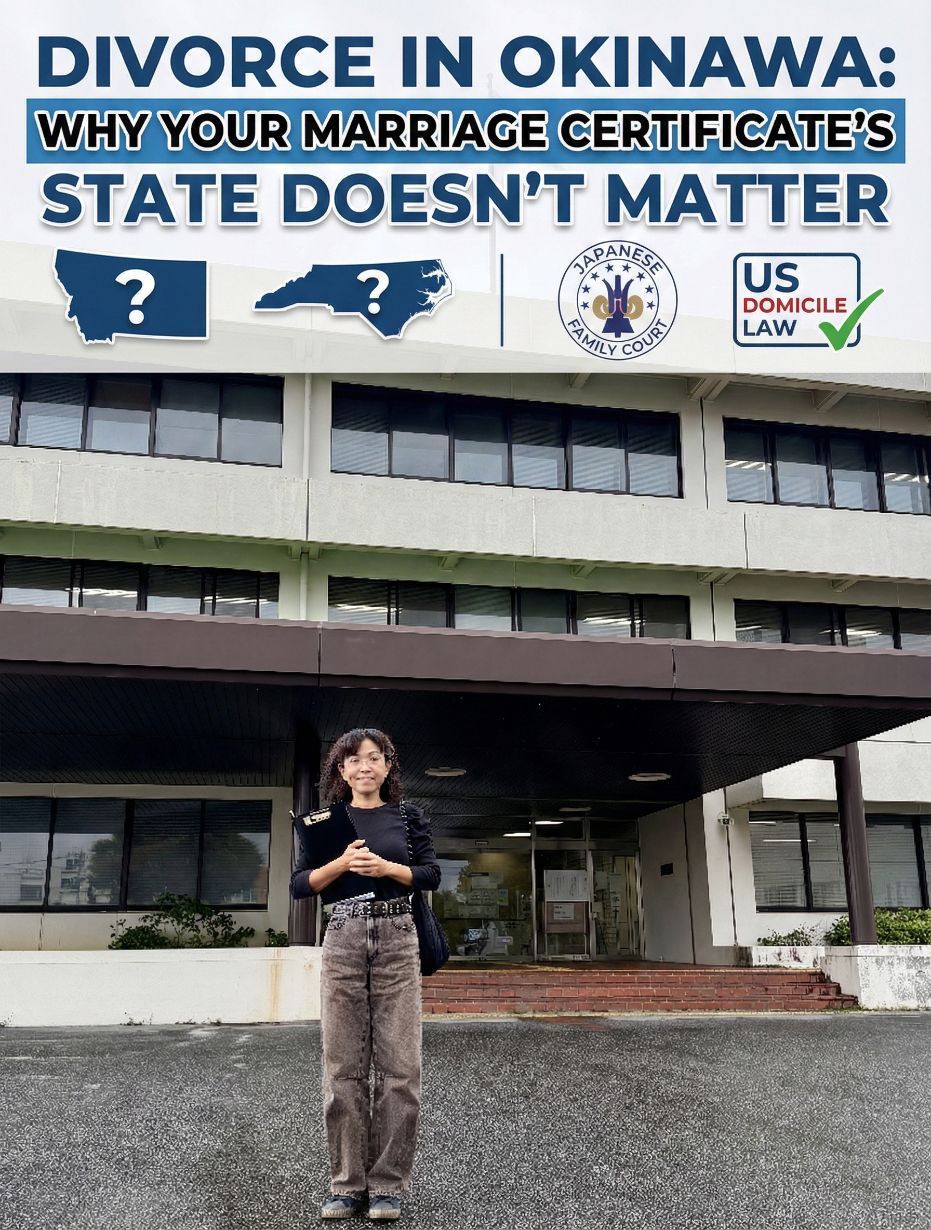
If you are a U.S. citizen living in Okinawa and considering divorce, you might be worried about the piece of paper that started it all: your marriage certificate.
We hear this question all the time at Dave Higgins Office:
- “I was married by proxy in Montana, will the Japanese courts understand that?”
- “We got married in North Carolina, so do we have to use North Carolina laws to divorce?”
- “Does it matter if my marriage certificate is from a state I haven’t lived in for years?”
The short answer is: No. The state where you were married does not determine which laws the Okinawa Family Court will use to grant your divorce.
It is a common misconception that you are “locked in” to the laws of the state where your wedding took place. In reality, Japanese Family Court judges look at who you are and where you live—not where you had your ceremony.
Here is a thorough explanation of why the origin of your marriage certificate doesn’t matter, and how the process actually works here in Okinawa.
1. Marriage Validity vs. Divorce Jurisdiction
To understand why the “Montana” or “North Carolina” certificate doesn’t dictate your divorce law, you have to separate two legal concepts:
- Validity of Marriage: This is about whether you are legally husband and wife. For this, the law of the place where you got married matters. If Montana says your proxy marriage is valid, Japan agrees you are married.
- Applicable Law for Divorce: This is about how you un-tie the knot. This is determined by your current circumstances—specifically your nationality, your “domicile” (home of record), and your habitual residence (Okinawa).
Once the Japanese court sees your marriage certificate, they simply check a box that says, “Yes, these two are legally married.” After that, the certificate’s job is done. The court then turns to a completely different set of rules to decide how to process the divorce.
2. The “Affidavit” and Your Home State
So, if the court ignores the marriage certificate’s state origin, what do they use?
They look at your Affidavit of Competency to Marry (or your assertions in the divorce filings) regarding your legal residence or domicile.
Under the Japanese Act on General Rules for Application of Laws (Horei), the court follows a specific hierarchy to decide which law applies to US citizens:
- National Law: Since the USA has different laws for every state, “National Law” means the law of your specific home state (the state where you vote, pay taxes, or intend to return).
- Habitual Residence: If determining a home state is difficult, or if the judge decides it is more appropriate because you both live here, they may apply the law of your Habitual Residence—which is Japanese Law.
This is the key: The court is looking at the address and state you identify as your permanent home now, or the fact that you live in Okinawa now. They are not looking at where you happened to be standing (or which proxy state you used) when you said “I do” five or ten years ago.
3. Why the Judge Might Use Japanese Law
In many of the cases we handle for U.S. citizens in Okinawa, the Family Court judge may decide to apply Japanese Civil Code rather than US State law.
Why?
- Common Habitual Residence: If both you and your spouse have lived in Okinawa for a while, the court often views Japan as the place with the most “jurisdiction” over your actual lives.
- Ease of Process: Proving the specific divorce statutes of a complex US state court system can sometimes be unnecessary if both parties agree to the divorce. Applying Japanese law (which allows for divorce by mutual consent/agreement) is often smoother and perfectly valid for US citizens.
Whether the judge uses your home state’s law or Japanese law, neither decision is based on your marriage certificate. It is based on your current reality in Okinawa and your legal home of record.
4. What This Means for You
You can breathe a sigh of relief. You do not need to worry if your proxy marriage in Montana is “recognized” differently or if you need to research the laws of the random state where you had a destination wedding.
When you use our services at Dave Higgins Office:
- We handle the explanation to the court: We ensure the paperwork reflects your current status and domicile correctly so the court has jurisdiction.
- We translate the result: Whether the court applies Japanese law or your home state’s law, the final Decree of Divorce issued by the Okinawa Family Court is valid. We provide the certified translation you need to prove you are divorced to authorities in the US (like for a passport name change or remarriage).
Don’t let the “Origin State” confusion delay your process. If you are ready to move forward with an uncontested divorce in Okinawa, the specific geography of your past wedding matters far less than your future here.
Contact Dave Higgins Office today to get started.